

September Reading Recap
Spoiler-Free Reviews

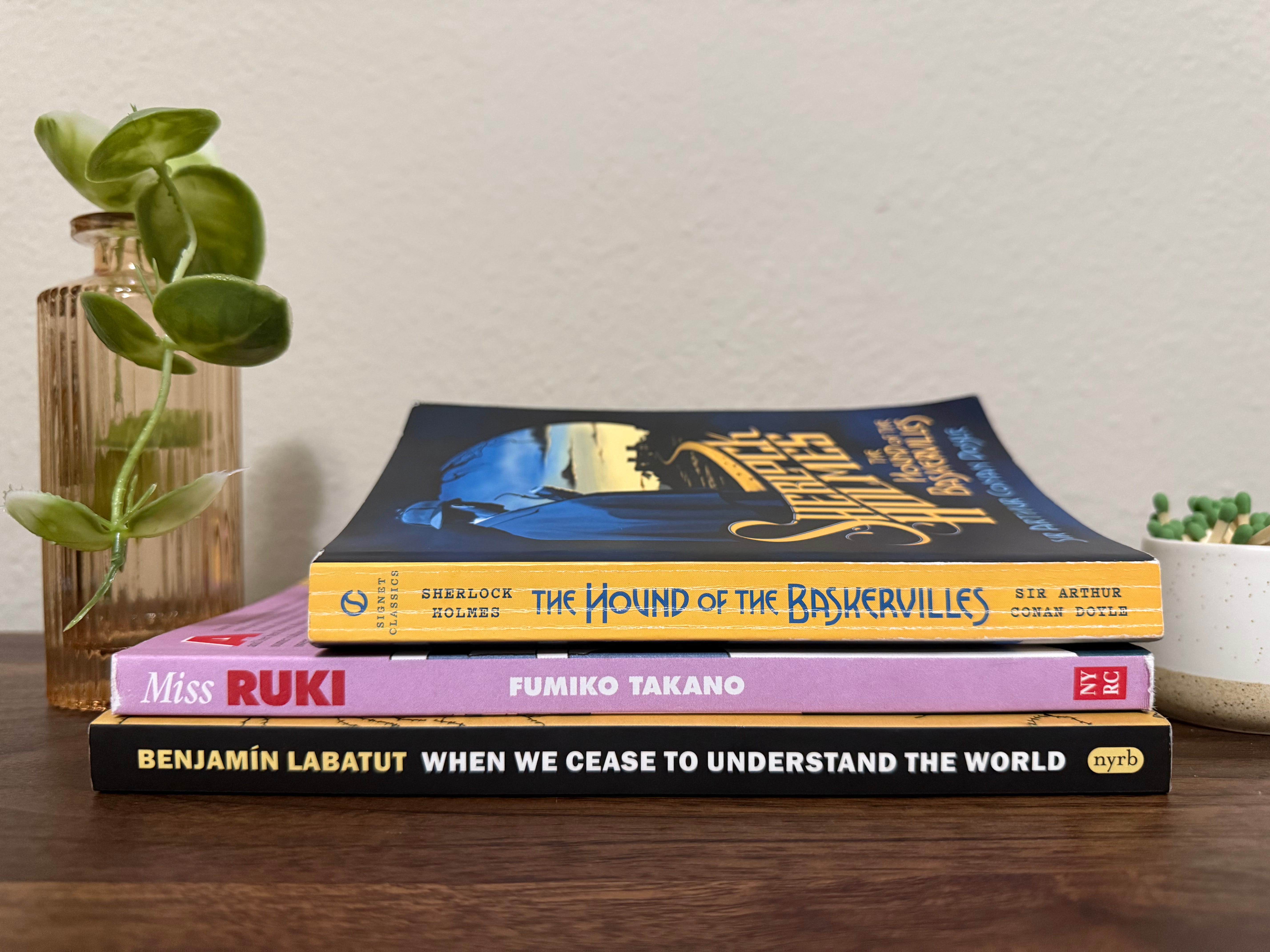
September’s category for the Men Read Fiction Too! Book Club was ‘Book by a Latin Author’ and the translated work of Benjamin Labatut’s When We Cease to Understand the World was the winner!
September Book Club Pick
When We Cease to Understand the World by Benjamin Labatut (translated by Adrian Nathan West)
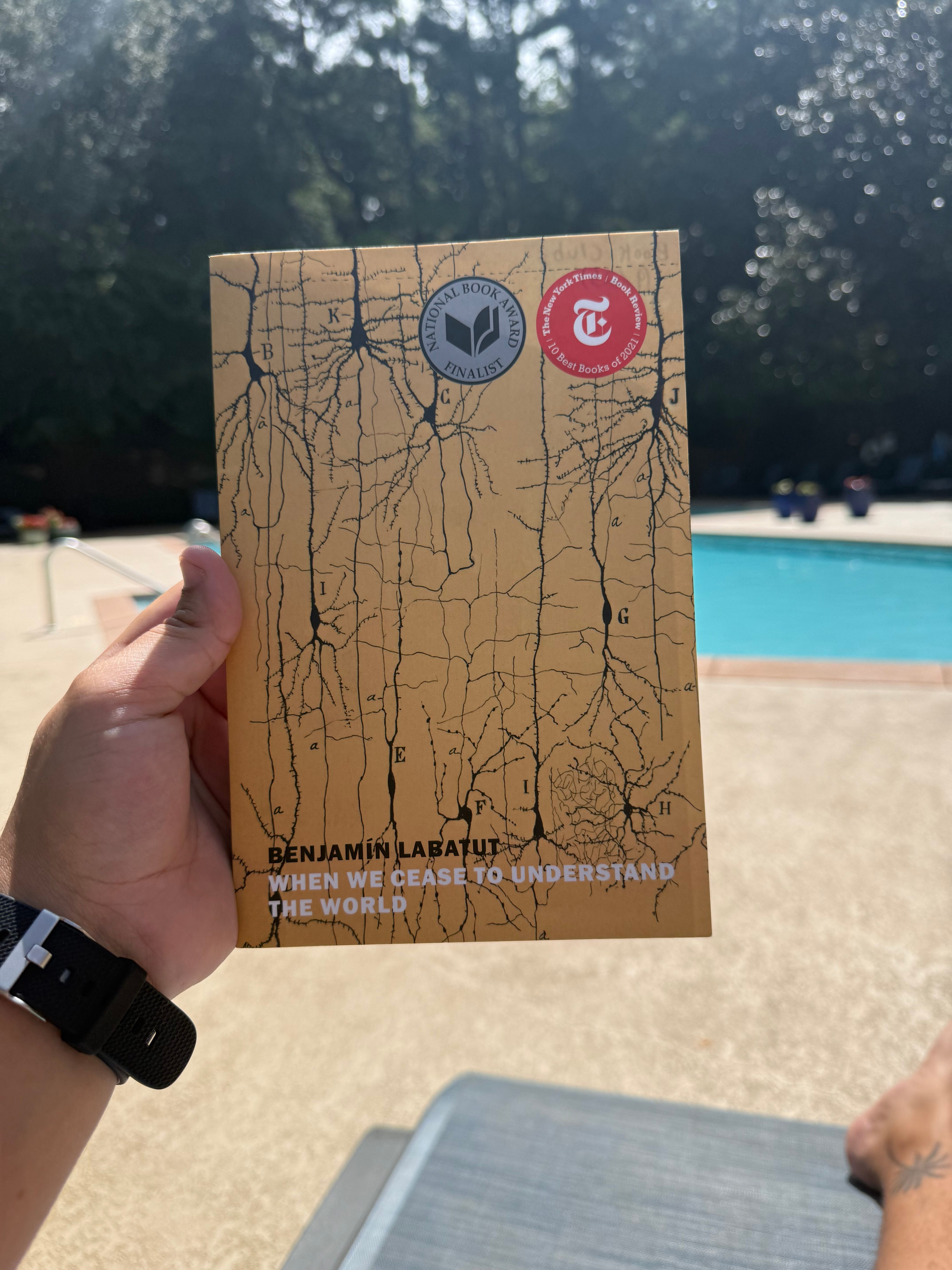
“The atoms that tore Hiroshima and Nagasaki apart were split not by the greasy fingers of a general, but by a group of physicists armed with a fistful of equations.”
I struggle to put into words my overall thoughts on this book. There is so much I enjoyed out of it and as a piece of art, I think it takes a swing that worked out very well.
The book is comprised of 5 short stories about the lives of renowned 20th Century scientists and the ripple effects of their work, as well as their madness. What Labatut does expertly is blend fact and fiction; with each story you read containing more and more fictitious elements to it. I found myself doing my own research as I read along to discern what elements are true and what isn’t. With the fictitious elements being a way to help us grasp with the reality of what’s put to the page.
You don’t need to understand quantum physics or any science for that matter to really appreciate the subject matter. Some of it may sound like science mumbo jumbo (it did for me at times) but you get the grasp on how these individual scientists understood these fields themselves. But what keeps this book incredibly engaging is how it flows. There’s a certain rhythm in the story as we learn more and more of these scientists. Their ideas and inventions take shape in ways one would never expect. It’s entrancing how one story will bounce around different time periods and still come out of it with a cohesive understanding on how things ended up the way they are.
There is so much to take from the title itself, When We Cease to Understand the World. Some of these scientists lose themselves and their understanding of the world they live in because they are too devoted to their field. Other times (like in Alexander Grothendieck’s case) they uncover a certain equation, a mathematical problem and uncover a whole other world comprised of numbers, but cursed to being the only one that sees that very world and still grasp little comprehension of that new world they see. It is also very much a story about ‘the limits of science’ as the author puts it. Not of the science itself, but in what man is able to comprehend from it.
It reminds me that these scientists were philosophers in their own right. Philosophy isn’t just about ethical quandaries, but also theory into how the world we live in operates on a granular scale. As someone who nearly failed most of their science courses, no work of fiction has ever made me want to learn how certain scientific fields work. So much of modern science is focused on practicality, what already is, etc. and little is devoted into the possibilities of what if. It feels like we lost something from that and as we continue to gain more technological advancements in our daily live, we don’t stop to consider what exactly they are to us. (Genuine question I’ve been asking myself because of this book is: what is the internet?)
All that said, this is one of my favorite reads of the year and the themes are as relevant now as ever as we face the new technological field of AI and the ramifications we’ll certainly be dealing from it. Could not recommend enough!
Personal Reads
Sherlock Holmes and the Hound of the Baskervilles by Sir Arthur Conan Doyle
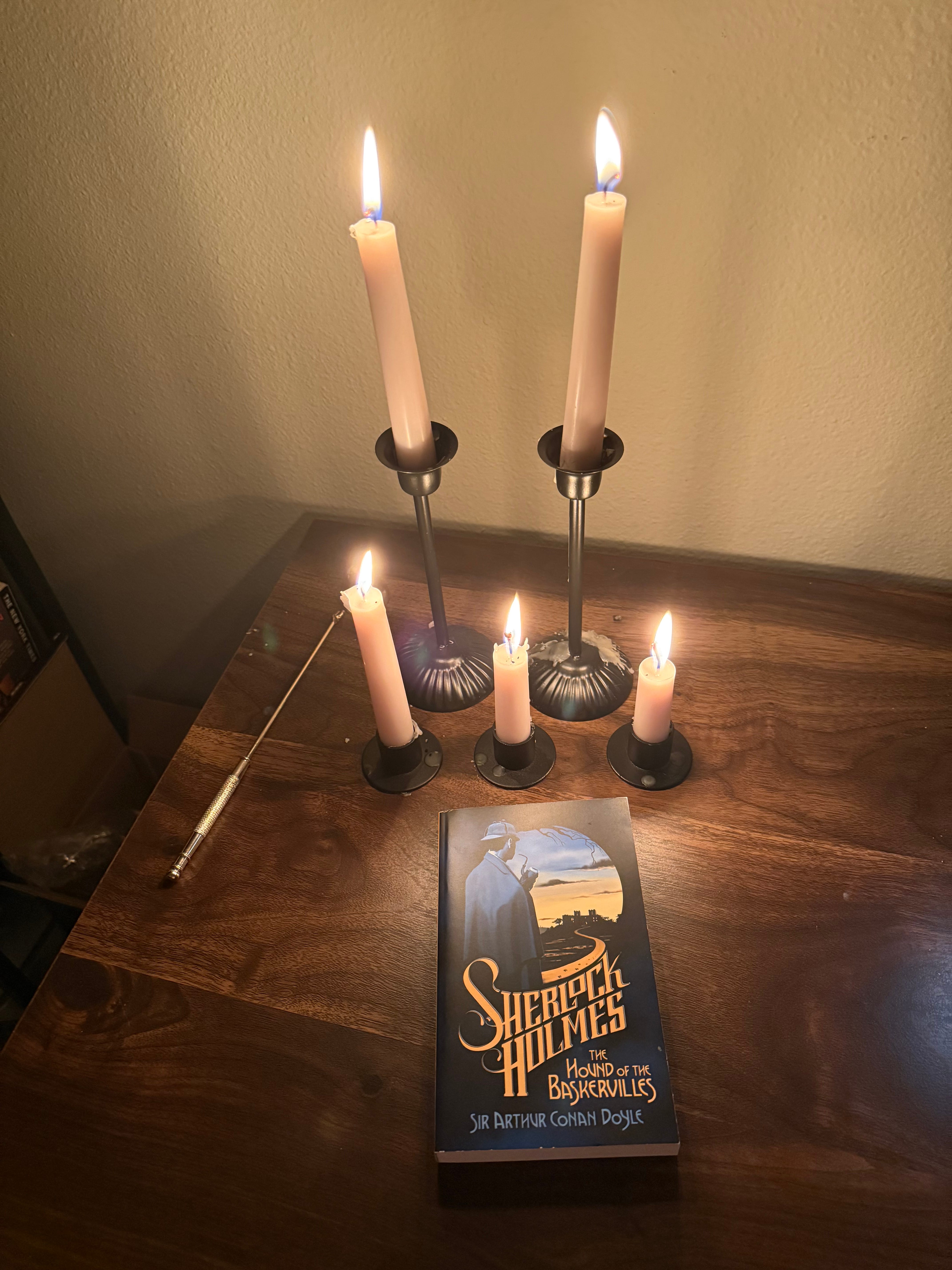
“Evil indeed is the man who has not one woman to mourn him.”
Admittedly, there isn’t a whole lot I can say about this novel. Many of us are aware of the eccentric personality of Holmes and his subdued partner Dr. Watson from the many adaptations on the classic duo. Despite it being my first Sherlock Holmes book I immediately felt familiar with our duo and enjoyed their dynamic. However, the story itself wasn’t as gripping as I thought it was. I’m sad to report that I found myself rather bored by the whole thing.
The mystery is enticing enough, very much like Scooby-Doo, where they try to debunk a supernatural crime with the reality of what really happened. And while I enjoy certain narrative devices to move forward the story, like the epistolary chapters, it wasn’t enough to entertain me. I wasn’t ever thrilled by the events that transpired and as someone who doesn’t read mysteries, I found it tedious to finish. While I can acknowledge it’s cultural impact, I personally
Having this novel be the most popular Sherlock Holmes story worries me that I won’t enjoy his other stories, but there’s only one way to figure that out. However, I’m not in any rush to read more anytime soon.
Miss Ruki by Fumiko Takano (translated by Alexa Frank)
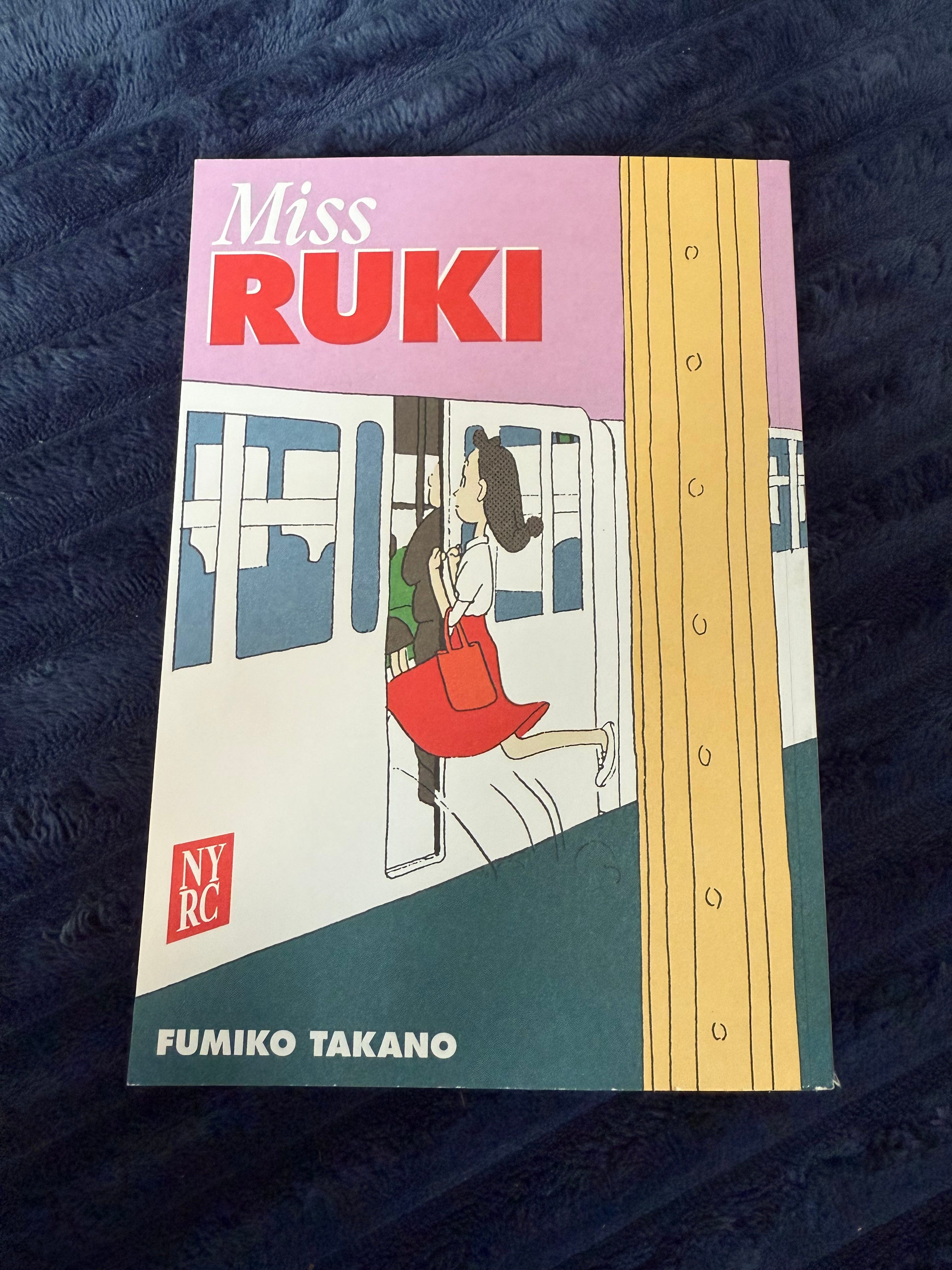


Charming, funny, and timeless are the 3 words that best describe this manga. This is a collection of 2 page vignettes of our titular character Miss Ruki and her friend Ecchan - two single women living in the booming economy of Japan in the late 80’s/early 90’s. It’s classic slice-of-life stories about trends, performative actions, and mundane living, that is filled with a light hearted humor for anyone to enjoy. Perhaps what makes this manga standout from many (and is probably why the publisher NYRB picked it up) is how incredibly modern it feels almost 40 years later.
The manga industry is a brutal industry that values quick efficiency to the detriment of its creators. And yet, Fumiko Takano isn’t all that interested in the industry to begin with. Much like Miss Ruki, she creates manga on her time, going through live with a relaxed ease that one can only wish to emulate. Instead, most of us are Ecchan - always trying to figure out the latest trends and how to get ahead in our career or life. You could easily finish this manga within a day, but you’d be doing yourself a disservice and is quite literally the antithesis to Miss Ruki. It is better to go at your own pace and take in every little detail to appreciate the simple brilliance of this manga.
Whether you’re an avid manga reader or a hater, there is a lot of joy to get out of reading it!
What have YOU read during the month of September? Have you read any of the books I read? Let’s talk about it!

You can read my other Monthly Recaps below and while all my articles will be free, I’d deeply appreciate if you became a paid subscriber. Writing is a luxury, but it is still a form of labor. Thank you!
I’ve never read any Sherlock Holmes I need to get on that
September reads for me were Falcons of Narabedla by Marion Zimmerman Bradley, The Sailor on the Seas of Fate by Michael Moorcock, and the 6 part serialized novel The Blackstone Chronicles by John Saul